A Thylacine in Paris
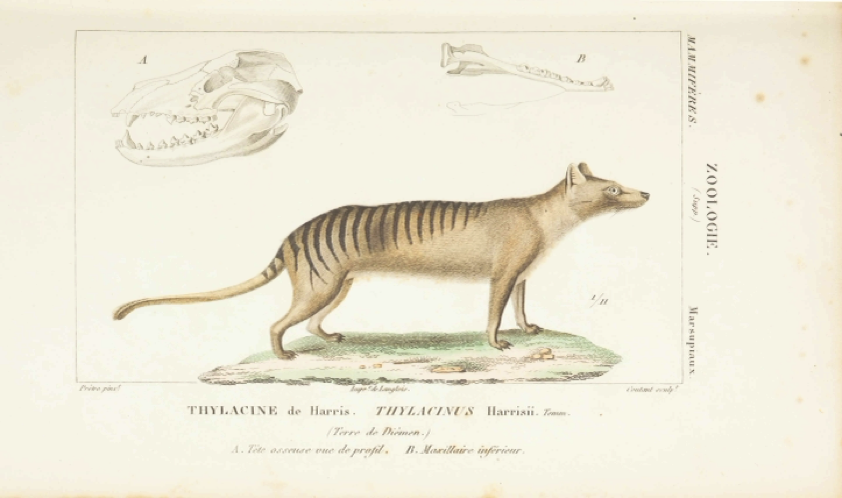
There is no thylacine in the fossil record of Paris. Yet in 1829, the French naturalist Georges Cuvier wrote that the bones of a species of thylacine had been found in the gypsum quarries around the city. The statement was wrong, but the story behind it is stranger than a simple taxonomic mistake - an Australian animal entered the history of a French fossil through its anatomy, and Cuvier's error would eventually acquire a second life in the digital archive.
In 1829, Georges Cuvier published the second edition of Le Règne animal. Included among the animals of Australia and Van Diemen’s Land was the thylacine, otherwise known as the Tasmanian tiger. The striped marsupial had entered European zoology only a couple of decades earlier, and Cuvier had described it under the name Dasyurus cynocephalus. After a short description of the living animal, he added a curious remark:
On a aussi trouvé dans nos plâtrières, les os d'une espèce de Thylacine (p. 178).
The bones of a species of thylacine have also been found in our gypsum quarries.
So, had an ancient member of the thylacine's lineage really been found beneath the City of Lights? The short answer was no. The long answer, however, was transformed by time.
In the 1839 republication of his discussion of Hyaenodon, Henri Marie Ducrotay de Blainville returned to the fossil Cuvier had presented in 1828. He rejected Cuvier's proposed identification, arguing from its dentition that it belonged instead to a non-marsupial predator. He established the genus Pterodon and named the species Pterodon dasyuroides. Cuvier had died in 1832, before he could formally establish and describe the fossil as a new taxon. Later palaeontologists revised the animal's position again, eventually recognising Pterodon as a hyaenodont, part of an extinct radiation of predatory mammals that lived in Europe millions of years before the thylacine evolved.
Blainville's reidentification did not erase Cuvier's earlier claim. The fossil changed identity, but the statement that a species of thylacine had been found in the gypsum quarries of France remained embedded in Cuvier's published text. Cuvier's sentence has proved remarkably difficult to kill. Part of the problem is the peculiar afterlife of a published mistake. Published under Cuvier's name and in one of the most significant zoological works of the period, the original claim acquired a textual life of its own. When Le Règne animal entered digitised archive, that sentence became easier to encounter than ever, while the correction remained embedded in the literature that followed it.
A statement printed in 1829, which once required access to a particular edition in a particular library, can now be located by anyone searching for the early history of the thylacine. The original claim is easily detached from the literature that followed it. Cuvier's words are searchable, quotable and reproducible, while de Blainville's correction requires the reader to follow the historical trail beyond the sentence that first attracted their attention.
This creates a peculiar kind of archival persistence. It is not quite the error itself that survives unchanged, but the statement announcing it. The fossil thylacine was not an enduring nineteenth-century discovery waiting to be confirmed; it was a mistaken identification that was corrected within a decade. What survives is Cuvier's sentence, repeatedly dredged from the digitised archive and sometimes mistaken for evidence simply because it can still be so readily found.
Cuvier's original sentence is an odd thing to encounter in an archive. Read on its own, it appears to record a remarkable discovery – a fossil thylacine in the gypsum quarries of France. Yet Cuvier's mistake was not arbitrary. The thylacine and its anatomy gave him something with which to make sense of an unfamiliar jaw. This was, after all, how comparative anatomy worked. An animal could be known through its parts, and an unknown specimen could be situated through resemblance to what was already known.
This is how an Australian animal could enter the history of a French fossil without ever having lived there. The history of the thylacine did not begin in Paris. Its anatomy did. That anatomy crossed the distance between Tasmania and France as a repertoire of anatomical characteristics, detached from the body that had carried them. Cuvier used those characteristics to identify an unfamiliar fossil, but when the identification failed, the specimen remained while its identity changed. More than a century later, digitisation gave the sentence another life, separated from the literature that had corrected it. What the archive preserves, then, is not simply an animal or a specimen, but the changing identities imposed upon them.